Migration

What is migration?

We were divided in 3 differents groups and each group should give his own definition of the term migration.

Groupe 1

– Migration it’s a personal or forced decision. It’s a movement of persons with the intension to settle (time) for a motivation(families reasons, the economie , religions, wars,etc…)
Group 2

– It’s a movement to a new area or a country to find better living or conditions.
Group 3

– People moving ( forced or voluntarily).

According to the UNESCO, Migration is Crossing of the boundary of political or administrative unit for a certain minimum period of time”.

We have 2 formes of migrations:

  • Internal Migration
    – territorial movement which does not lead to any change in the social membership (eg. Turism).
    – Relocation in which the individualsa or the groups concernerd are purely passive objects (eg. Refugees).
  • International migrations

Migration started with the movement of the first human groups from the East Africa to their locations in Europe. We have differents types:

1- Temporary labor migrants (tourists)
2- Highly skilled and business migrants ( for work)
3- Irregular migrants ( clandestins)
4- Forced migrants (refugees).

-It’s a movement of people for one place to another with the intention of new location (temporarily or permanent).
!: Nomadic movements are normally not considered as migration, because they don’t have the intension to settle. E.g. Roma people.

• The temporary movement of people for the purpose of travel, tourism, pilgrimages, etc.. is not regarded as migration.

• Mobility experiencemap

Mark on the map all the places where you have been (holidays, tourisms, travel, etc …).

Europe and America remains the continents most sought for migrations.The Principals reasons are:

1. Bad or lack ( of )informations about other part of the world,
2. geopolitical issues,
3. The Lack of financial ressources to explore elsewhere.

Action Around The World!

Wednesday, November 25. It is the second day of our Training Course, and we are slowly getting to know one another. Not an easy task. What is your name? And tell me again, where are you from?

Your Blog Team: Josh & Marieke

Officially, there are 7 countries present: Romania, Serbia, Germany, France, Georgia, Netherlands, and Italy. In reality, we represent many more countries. Next to the participating countries, some of us have their roots in Portugal, Bosnia, Morocco, DR Congo, Australia and the US. Also, there are participants that have information to share about countries that do not belong to either of these groups, but are current host-countries to the participants: Norway and Denmark. All together, we are connected to 15 countries around the world. Not even mentioned are the countries we visited and lived in for certain periods of time … If you ask us, we are definitely ready for some Action Around The World!

Getting Ready for Action
Josh serves Healthy Food


World Cafe

The World Cafe provides for collective learning:

“People already have within them the wisdom and creativity to confront even the most difficult challenges; that the answers we need are available to us; and that we are Wiser Together than we are alone.“

More information about the World Cafe method.

The World Cafe method is designed to discuss and reflect on different large topics. A group of people starts at one table, discussing a question/topic related to the theme of the workshop, and doodles their answers on a flip chart. Afterwards, there are several rounds, in which participants go around the World Cafe, to learn about the different topics, while discussing and adding to the flip chart. There are as many rounds as tables, so that each participant has the chance to learn about all topics.

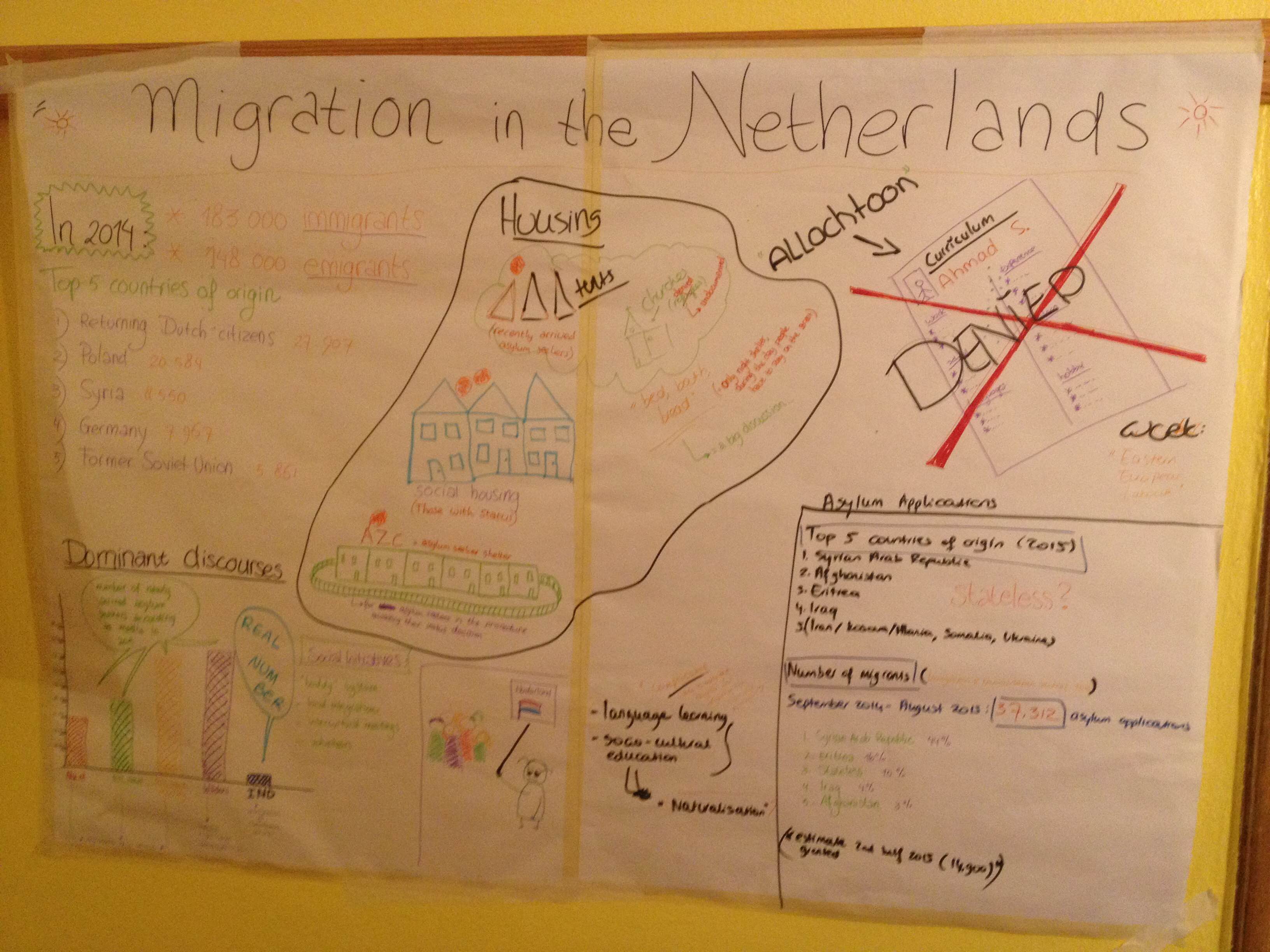
In our World Cafe, we had a slightly different approach. All participants had been asked to provide basic information on migrants in their countries, previous to the start of the Training Course. What are their countries of origin? What about living conditions? What is the media discourse on the topic? How are migrants and refugees related? On our second day together in Berlin, the country groups got together and collectively worked on the presentation of their data.

Serbia
Serbia
Romania
Romania
Netherlands
Netherlands
Italy
Italy
Georgia
Georgia
France
France
Norway
Norway
Germany
Germany

In order to create an even deeper World Cafe setting, we suggest to ask participants to bring typical sweets from their countries. The different tables would then get an actual taste of the place. Also, it would be good to keep track of time during the second phase. In that way, participants spend a certain amount of time at each table, and no information will be overlooked.

Games

Games are an interesting way to make a group activity because it allow people to keep the concentration and good humor.
We had differents interesting games, but one of them  was more interesting :

We created two circles, one inside the other. Sitting face to face (those of the inner and outer circle), leaving a corridor between us. At the sound of the music, all we got up, moving to the rhythm of the music, while respecting the order of the circles. Once the music stopped, we should sit on the chair which is closest to us, having a new different partner with whom we should ask mutually  questions and answer to that, according to what the organizer asks us.

Examples:

  • What will you do with 1000.000 euros?    
  • What is your best travel experience

It was a very interesting game, because it allowed us to discover each other and foster communication.

Welcome and References Wishes and fears


Welcome time!

I remember again my first lesson in primary school, teaching us about the rules of politeness

Greetings and presentations are two important things before to start any activities in groups or in society. This promotes and facilitates community life, especially when we are called to work and to live for a long period in group. It’s also a way to break down barriers between participants themselves but also between organizers and paricipants to allow familiarity between people.

This part allowed everyone to express his expectations and fears related  to the training. It‘s in this atmosphere that we express ours fears and expextations, receiving encouragements from the organizers.

Migration patchwork

After the activity picture journey we took a café break, and we moved after to the last topic of the day which is “migration patchwork”, in which we started by working on the world map, and we were invited to go to the whiteboard and indicate our mobility and after we found out, the countries or the continent that know the high level of mobility, and we had thereafter a discussion about the reasons could be behind the choice of people to migrate to a continent and not to another.

After the organizers have presented some definitions of migration, the types of migration and also what is not regarded as migration.

Picture Journey

After the lunch time we started the activity “picture Journey”, during which each participant has presented and showed to others his/her pictures related to his/her experiences with migration issues, mobility or any other youth program in which he or she has taken part. During this activity we have presented the aim of the program of the activity and what we have gained in term of competences and the conclusions that could be drawn from this experience.

Also after showing the different pictures, we tried to find together a definition to migration, the key words that can define migration, and we have agreed in the following key words:

  • Movement of people from an area to a new one
  • Looking for better living conditions
  • Due to different reasons: economic, political etc.

Programme & Communication/ Get to know each other

We have organized funny games between participants in order to have more energy during the day, and also for getting to know each other’s better.

After the organizers have presented the program of the training and have given us an idea of the different topics that we will be discussing during the training course.

After the program presentation, the organizers have presented the rules of communication that we have to respect during the TC, among this rules, we can state the following ones:

  • Everybody has a room to speak
  • Constructive criticism
  • Show respect to each other and don’t interrupt during one’s speaking
  • Give immediately feed back
  • No judging
  • Be calm in the sleeping room while people are sleeping
  • Accept the personnel borders of others

Wishes and Fears

There after we did the activity “wishes and fears” during which we were invited to write in cards our expectations toward the training course and also our fears.

In fact, as examples of expectations that the participants have mentioned, we can state the followings:

  • Discover new cultures
  • Share experiences
  • Acquire new competences and pedagogical methods
  • Etc

And among the participants fears we can highlights:

  • Conflicts between participants
  • Misunderstanding and personal judging
  • Etc